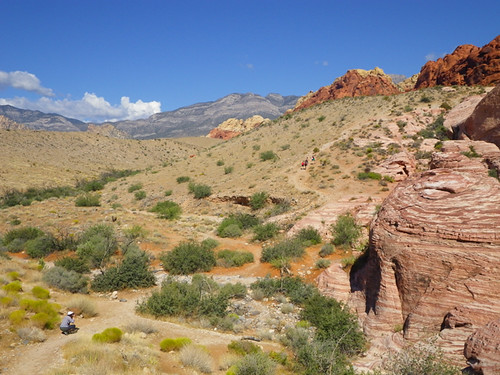
Pink Laurel is a two-star classic you don't often see people doing. It looks intimidating. It sits just to the right of some very popular, easier climbs like Jackie (5.5) and Classic (5.7). The first pitch ascends a corner system, with the crux coming low at an escape from an awkward alcove. When we arrived at the base and looked upward, it seemed to me like the dark, awkward alcoves continued throughout the whole pitch.

(Photo: Maryana pondering the crux alcove on pitch one of Pink Laurel (5.9))
Maryana was more than up to the task of climbing the pitch. Although there were placement opportunities, she didn't put in any gear until she got herself through the easy starting territory and into the crux alcove. Once there she placed two solid cams. At the time I was ignorant of what was to come, so I didn't know to tell her what I'm going to tell you now: I'm not sure those two cams were placed optimally. If she'd blown the crux move they would have kept her from hitting the ground, but maybe not the rock at the base of the alcove. Maryana placed the cams in the ceiling of the alcove, one in the crack on the left and one in the crack on the right. Because the cams were set back a bit from the lip, she extended the draws on both of these pieces. Better, I think, would have been to place a cam right at the lip of the roof of the alcove, clipping it direct. No extension.
But she was totally solid on the moves, so there were no worries. As soon as she stepped up out of the alcove, I suggested she place a piece ASAP, which she did from a rather strenuous stance. Then it appeared the climbing eased for the rest of the pitch.

(Photo: Maryana almost through with pitch one of Pink Laurel (5.9))
When it was my turn to follow, I saw why people gripe about Pink Laurel. The polished part of the route is short, but it is the crux. Dick tells you to undercling left out of the alcove, but this advice only tells part of the story and doesn't begin to capture the weirdness of the move. It is a committing undercling up left with very slippery feet, then a step right, awkwardly straddling a corner. Another strenuous step up and you're out of the crux.
I didn't think the moves were hard, exactly, but they were strange and insecure. Very good protection is available but as I realized watching Maryana some care should be taken to protect the crux well.
I thought the climbing above the crux was interesting and unique. The remaining alcoves went at around 5.6, and there were some funky moves required to get out of them. Before I knew it I was at the ledge with Maryana.
Pitch one of Pink Laurel was very interesting, and a little different from your typical Gunks climb. I'd like to go back soon and lead it myself.
And I'd really like to go back and lead pitch two again because I totally botched it with Maryana.

(Photo: Vass leading pitch two of Pink Laurel (5.6 variation))
Last fall I did the 5.6 variation to pitch two of Pink Laurel with Vass, sending him up on lead after I led pitch one of Jackie. This easier variation of Pink Laurel is fun (I thought it seemed pretty soft for 5.6), and it led me to believe the 5.9 version of the pitch wouldn't be too difficult, because the crux would have to be short. Both versions of the pitch, easy and hard, start and end the same way. The only difference is that the 5.6 version cuts left around the roof while the 5.9 version cuts right.
Returning to the pitch with Maryana, I set off, getting to the stance atop the prominent pointed flake (just over Vass' head in the photo above) with ease. Then I headed right, towards what I thought was the 5.9 finish. An overhanging 5.7-ish traverse around a little nose led me a stance at a shallow left-facing corner. Here I looked up and could see a big angle piton in the roof above and to my left. I thought that this piton must be at the exit to Pink Laurel, but I wasn't sure I was supposed to go that far back left to exit the roof. It seemed especially contrived to go back and left when I was already standing at an easy-looking corner that seemed to go straight to the top.
So I went straight up the corner instead of heading back up and left, and since the climbing to the top couldn't have involved any moves harder than 5.5, I knew I'd messed up.
Later I looked at the photos in the guidebook and realized I'd traversed too far to the right, going all the way to the finish of A-Gape. This climb is a 5.11 down low but the part I did is easy and from all appearances seldom climbed. Judging from the line in the book I went straight right when I should have gone diagonally up and right from the stance at the flake. I don't know how I missed the line so completely.
Now that I've avoided Pink Laurel's second pitch from both sides, I have to go back and attack it directly!

 The other day I was cycling on a busy road where the city has recently installed those raised-platform intersections to make the cars slow down before crosswalks. Ahead of me, I saw a cyclist brake just as she entered the intersection - probably hoping to reduce the impact of the bump. Watching her, I somehow knew what was going to happen next and winced. And then it happened: As her wheel hit the raised platform, her bicycle flipped over, and she with it. All this occurred at a slow enough speed, so that she wasn't hurt and was soon back on the bike. But I suspect that she has no idea why the fall happened, which means that it might happen to her again.
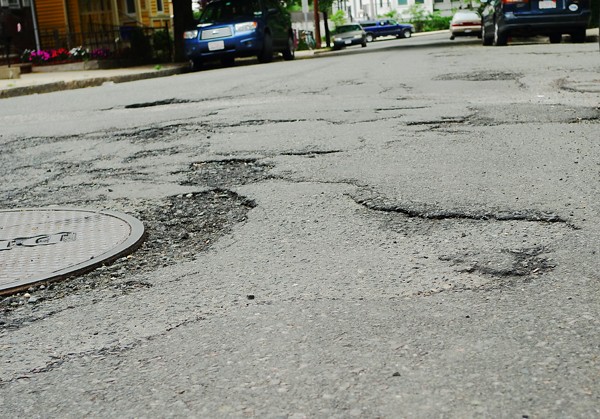 To me, it has always seemed self-evident that it is "bad" to brake while going over bumps, and watching the cyclist's fall confirmed that. But were there actually any facts behind this belief? I got home and looked it up, stumbling upon Sheldon Brown's explanation.
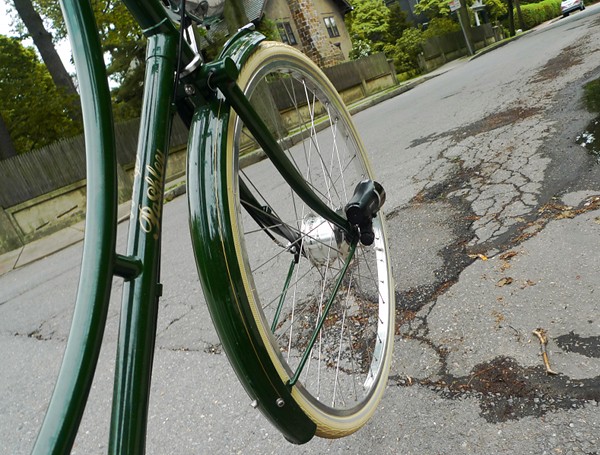 When we find ourselves hurdling towards an obstacle n the road that we cannot avoid, naturally the reflex is to slow down. But this should be done
  Of course, this is just one more reason why I love coaster brakes for cycling in the city. If you're used to braking with a coaster brake in order to slow down, you do not rely on the front brake as much and are not likely to squeeze it while going over a bump. I know that some will not agree with me on that one, but that is how I see it, and the coaster brake has been a reliable ally for me in pothole-ridden Boston Metro.
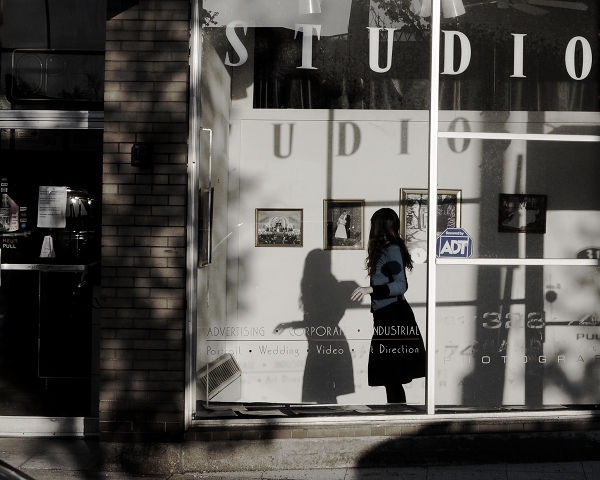 The only problem? Well, something about this town just seemed off as soon as we got there.
 It was as if the shadows in the town center were extra shadowy.
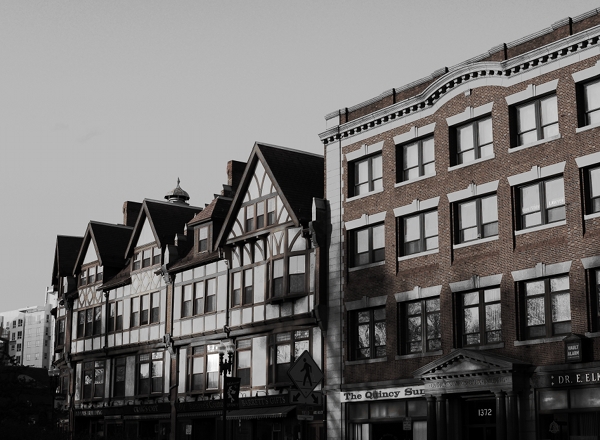 And the sun-lit rooftops exuded a sinister gleam.
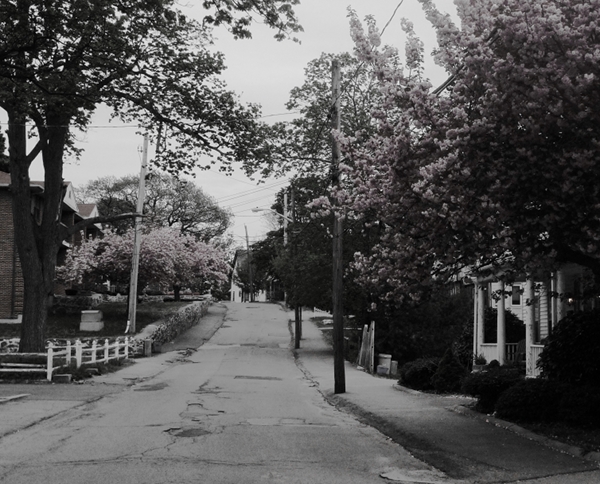 Even the quiet side streets were eerie. What could it be?... Oh yes. There was hardly a bicycle to be seen! Honestly, I cannot remember the last time I saw a town with so few bicycles. Over the past weeks we have been moving our things into the studio and renovating the darkroom, and I've spotted a total of maybe half a dozen bikes in the streets during that entire time period -mostly being ridden on the sidewalks.
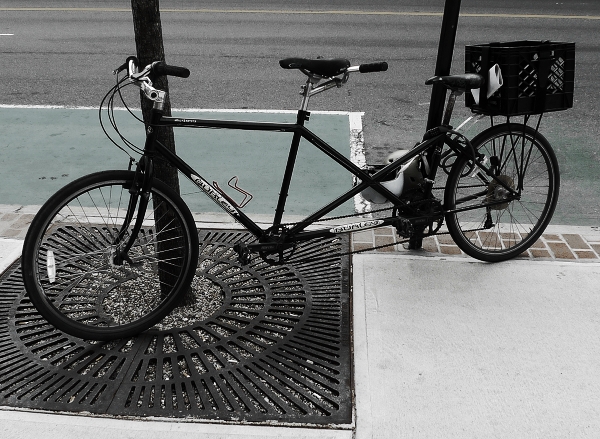 This singular bicycle stood out in No-Bike Town like a lone cowboy. It is an interesting


 At 7:00 am, we are off to the office via the Danube Canal Path - which functions like a cross-town bicycle highway through Vienna. It just so happens that both my flat and my office are close to the canal, so our route to work is pretty straightforward. Pictured above is the nearest entrance onto the path.
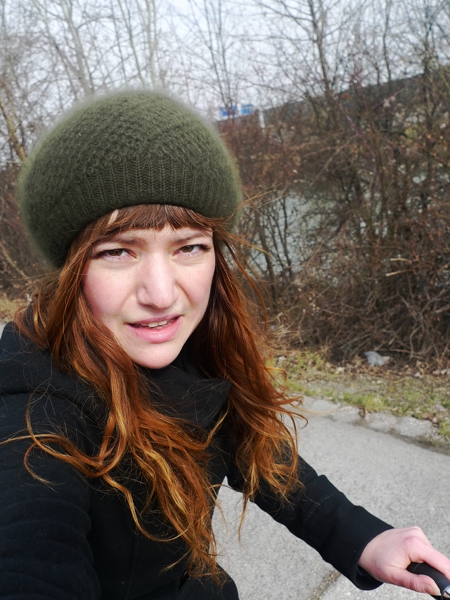 The Danube Canal is an offshoot of the Danube River. Both the canal and the river proper have bicycle paths running alongside, but the advantage of he canal path is that it cuts through the center.
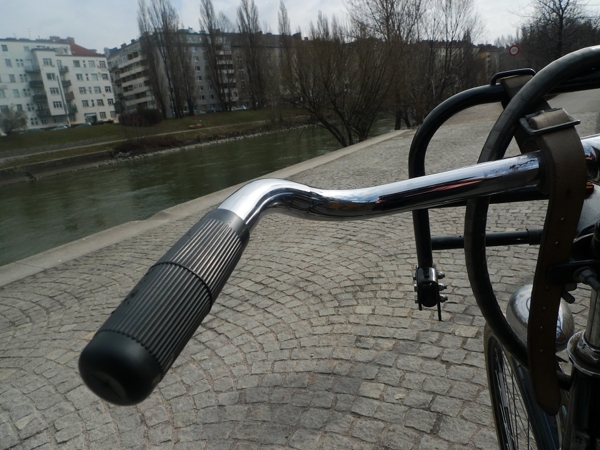 One thing I like about it, is how green the water looks - especially in the morning. No idea whether this is due to reflection from trees or chemical pollution, but it looks nice and so I choose to believe the former.
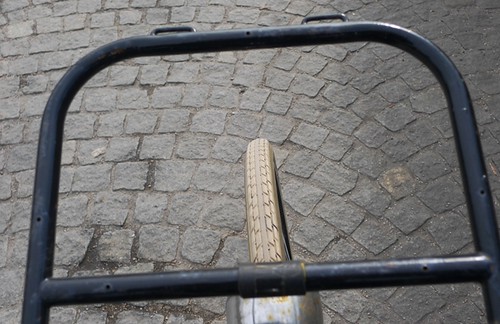 There are some cobblestone stretches along the path, and the 28" Schwalbe Delta Cruisers on Jacqueline are just fine with them. But I have seen other cyclists get off their bikes and walk here.
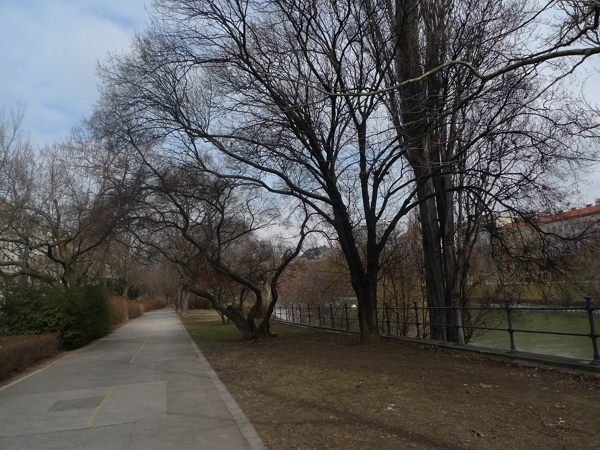 Some parts of the canal path are woodsy and surreal-looking.
 Jacqueline enjoys this sort of scenery the most.
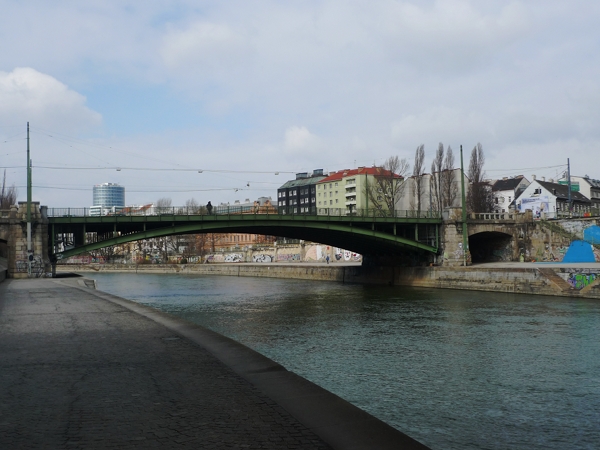 Other stretches are more urban and take you closer to the main road.
 That's okay too, but cycling here during rush hour will give you a nice helping of auto exhaust fumes. Have others noticed this problem in large cities? I have been told that automobile emissions in Europe (not counting former Eastern-bloc countries) are supposed to be less toxic than in the US, but my lungs seem to disagree. If anybody has more info about this, please share.
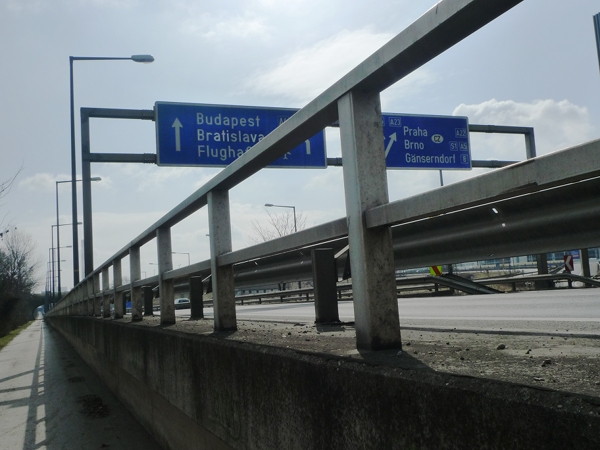 Heading toward the Southern edge of town, the scenery on the Danube Canal Path grows distinctly less picturesque. We are now cycling alongside the highway. And yes, that is a highway sign for Budapest and Bratislava. Bratislava (capital of Slovakia) is only a 45 minute drive away from this point. But instead of going there, Jacqueline heads to the office.
 The landscape around my place of work is somewhat post-apocalyptic, but over time I have grown fond of it. Lots of interesting research facilities there, and I work with nice people. The total time it takes Jacqueline to cycle to the office from our flat is 20 minutes - the exact time it takes to commute using public transport.
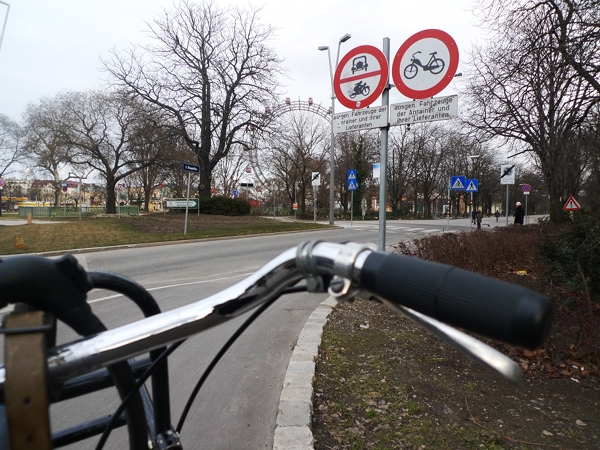 I rarely stay at the office all day, but typically have meetings all over the city. On this day I had an afternoon meeting in a Cafe at the end of the Prater - the largest park in Vienna.
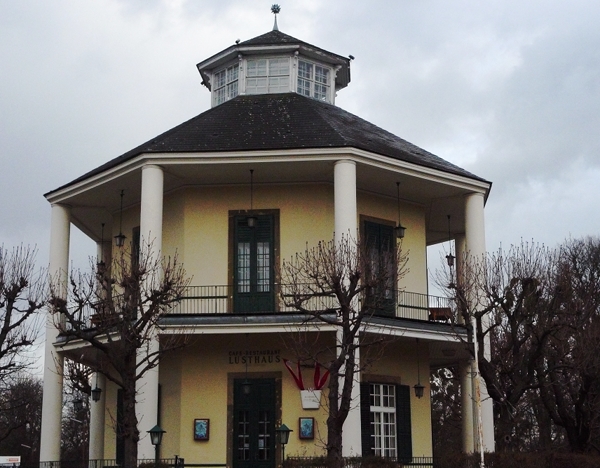 Lusthaus Cafe. Before you misunderstand what I do for a living - it's not what is sounds like in English. The name means "funhouse". This was about a 10 minute ride from the office for Jacqueline. After the meeting, we briefly returned to work, leaving in the late afternoon to run some errands.
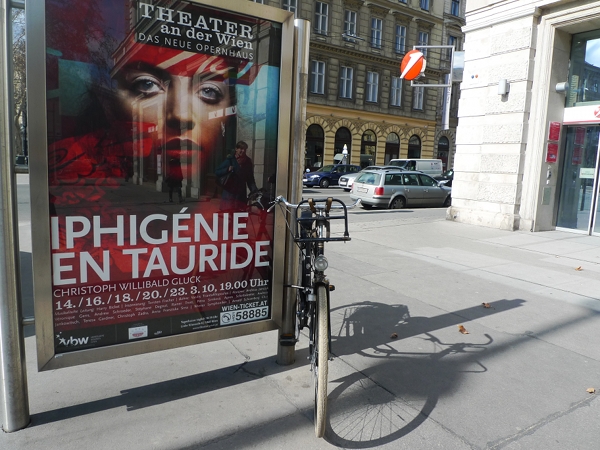 First stop: the bank, in the city center, a 25 minute ride away. To get here, Jacqueline rode back via the Danube Canal path, and then along the Ring Road - which is another "bicycle highway" that loops around the city center.
 Jacqueline then proceeded to the photo store in an adjacent district - a 15 minute ride away - to buy some film. She rode there mostly on the road, via a combination of bicycle lanes, "sharrow"-marked side streets, and unmarked side streets. The thing about "sharrows" in Vienna, is that they are mostly painted on 1-way streets
 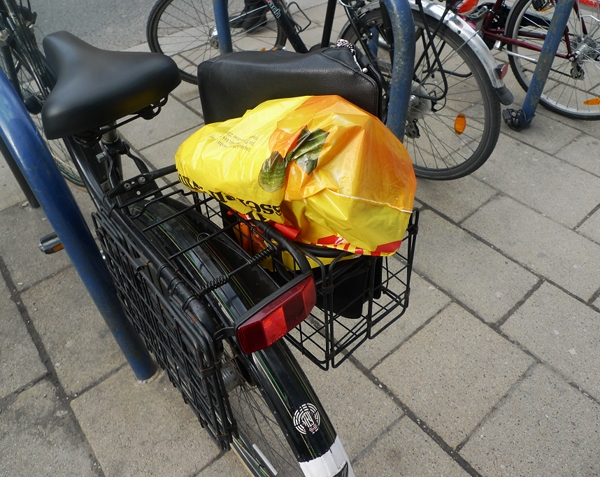 After the photo store, Jacqueline was locked up on a main shopping street and waited a bit while I met a friend for coffee. Then we went to the grocery store
  Jacqueline was proud that she could fit 1/2 week's worth of groceries
 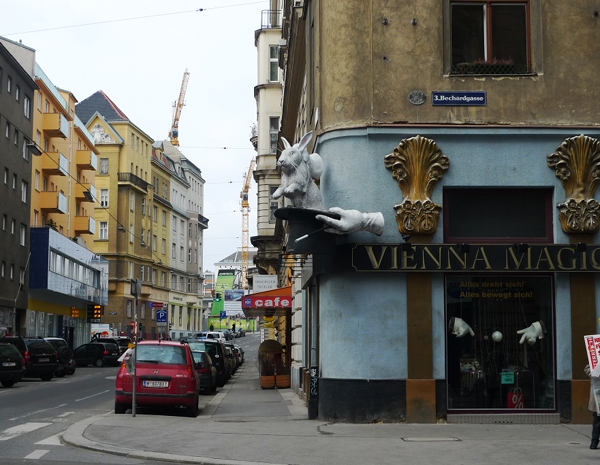 As dusk approached, we cycled home - once again via a combination of roads, then the Ring Path via the route described here. All in all, I would estimate that Jacqueline did a couple of hours of back and forth cycling, and this was typical of how much I travel through the city on an average day in Vienna. Normally all of these trips would have been done using public transport. The travel time by bike is about the same.
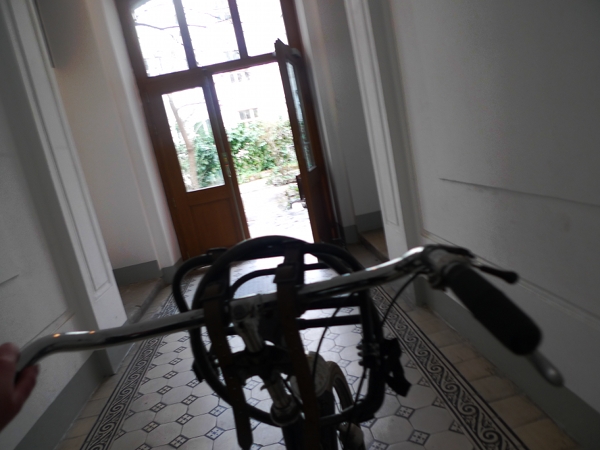 I rode Jacqueline for transportation for the last week of my stay in Vienna. It was wonderful and made up for my bad luck earlier this month. I now feel like an idiot that I didn't just buy a bicycle when I lived here for longer stretches in previous years. Cycling in the countryside on my days off was nice, but I have to say that commuting by bike in Vienna is even nicer. And regardless of what the local shops might tell you, a 3-speed is sufficient to tackle "hilly Vienna". I am by no means in the best shape and had no trouble. Of course, the vintage magic of Jacqueline might play a role in that as well. But in any case - if you are in Vienna, get a bicycle and enjoy the city, whether you are a leisurely visitor or work at a fast-paced job!

