
My parents George and Bebe were born and raised in Washington DC, but this isn't really a DC story so much as a love story that happened here. As far as I know my mom and dad have always tried to celebrate Valentine's Day. Maybe it was because they had a rare sort of love- the kind that lasts. They met while still in high school at Western and weathered deep family disapproval over their multicultural backgrounds. My grandfather forbid all his local business friends to hire his son in an effort to thwart the young couple's chances long enough for my father to come to his senses- which he never did. He stayed in love with my mother for over seventy years. And it's not too dramatic to say that only death could part them.
That's a lot of Valentines.
Though my father was a warm and funny man, he rarely showed his romantic side, but I have written proof:(Get the Kleenx now)
Here is a note my father wrote sometime in the last 10 years when he was in his eighties:"Dearest One,Why can I not say the words I can write. At least once a day and sometimes more often I think how much I love you, not only as a wife, but as a friend and companion....My love is 60 times stronger as each year has gone by."
Or this one written when they had been married over 65 years:
"As we sit night after night watching T.V. I often think what a beautiful woman you are not only in body, but also your mind."
Most of these he signed "George", but I liked the one that ends "Love, Your What's His Face- GPC"
My father died shipboard one year ago today, but he had thought ahead and bought my mother a valentine before they went on what would be their last cruise. We found it unsigned. It was one of many such trips that my father worked hard for all his life. On one of their first cruises, my mother spotted a clause in the contract that stated a child could stay in their room for free. I was the baby of the family, but in my early 20s I wasn't up for bunking in with the parental units. My older sister, however, had raised a family and divorced by then and was happy to go. (She was here after known as "the child.") On their last cruise, my father tripped on the stairs and that was pretty much it. My mother blames the sneakers he was wearing. We still find it easier to pretend he isn't really gone, but he is.
My dad loved many things- his family first. He loved dogs, and cars and Home Depot. He loved to travel especially to Greece. He loved the beach. He loved chocolate, Tootsie Rolls, half smokes and Greek chicken with macaroni. He loved to tell stories. He sang and sneezed loudly and could make a great egg sandwich. He loved practical jokes, and getting a bargain. He loved to make people laugh.
And now I know he loved my mother with a fierce and steadfast heart that continues to inspire me even after he is gone. That unsigned valentine speaks volumes now.

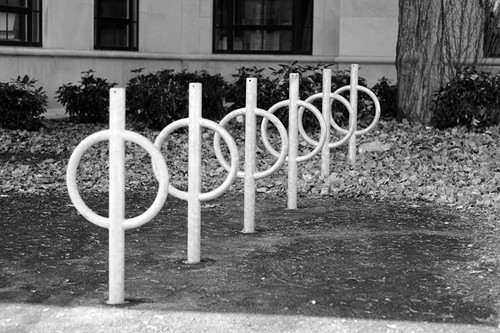 Although there are plenty of complaints about the lack of bicycle parkinghere, my impression is that the greater Boston area is better than many places in this respect. There are bicycle racks all over shopping districts, outside post offices, libraries and prominent places of business, next to transit stations, throughout college campuses. But I notice that cyclists do not always choose to use the racks, preferring to lock their bicycles to alternative structures instead. There will sometimes be a rack that is almost entirely empty, and nearby there will be some bicycles locked to trees and sign poles.
 The other day I saw a group of cyclists locking up their bikes outside a cafe - each one of them ignoring the racks and going for random other structures. I commented about it, and we had an interesting conversation. Here are some of the reasons they gave for not using the racks provided:
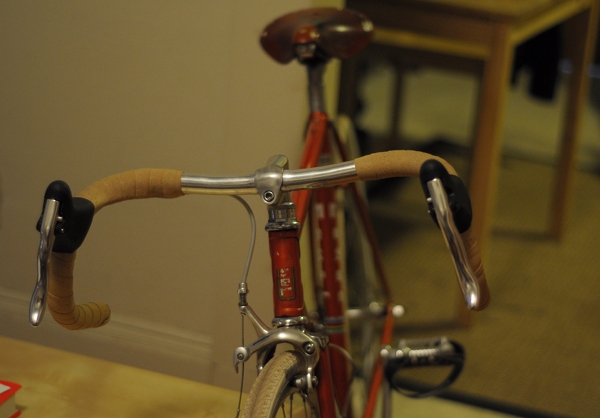 Last weekend we finally picked up my Francesco Moser fixed gear roadbike from Harris Cyclery, where it sat most of the winter after getting its bottom bracket replaced. I haven't been on this bicycle since December, riding the slightly-too-big-for-me Bianchi instead. And now that the Moser is back, guess what? It feels small! I was warned that this would happen once I got used to a larger frame, but it's still hard to believe. How can I feel cramped on a bike that felt "perfect" last year?
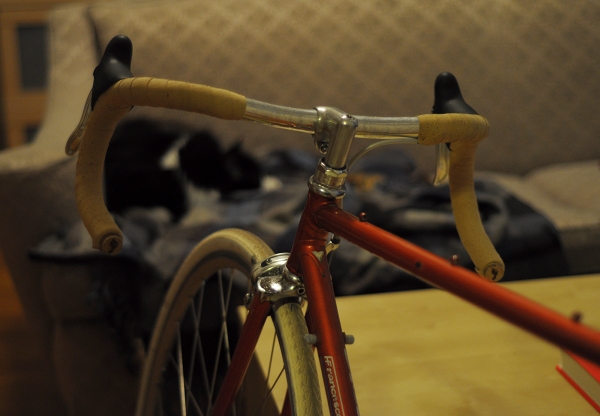 In addition to having a shorter top tube than the Bianchi, the Moser is also set up with a shorter stem. The difference between thetotal distance from the seat post to the handlebars on the two bikes is 3cm - which seems like a small number, but feels quite otherwise, at least to me. The handlebars on the Moser are also set quite a bit lower, which I think contributes to the cramped sensation. Combined with the lower bottom bracket, I almost feel like an adult on a miniature pony when I mount the smaller bike after the larger one.Would a longer stem alone solve this, or have I "outgrown" the frame itself?At the moment, both myBianchi(with a 55cm top tube and 8mm stem) and myRivendell(with a 57.5cm top tube and 6mm stem) feel just right, but how can I trust that "just right" feeling when it keeps changing?
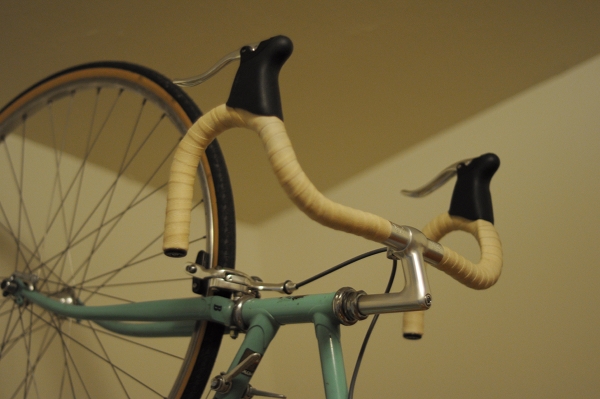 It is said that preferences in bike fit "evolve" over time. But does there eventually come a point when they stabilise? How many times in your cycling history has your idea of comfortable bike fit changed?
 And this is the beautiful ocean, full of big waves today!

 With the Urbana bike temporarily in my possession and the Surly bikes we rode last week-end, I have suddenly undergone a crash course in threadless stems. Though of course I have seen them on bikes before, now I got to actually play around with one and understand it firsthand.
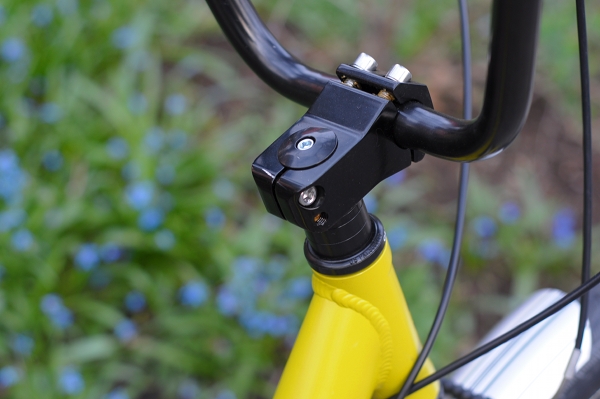 Of course the other major criticism of threadless stems is a practical one, and it is one with which I do agree: While quill stems can easily be raised and lowered to adjust handlebar height, threadless stems cannot. When buying a new frame meant for a threadless stem, there is a process (which I only half-understand), whereby you decide on the handlebar height you want, and they cut the steerer tube accordingly, then attach the threadless headset, spacers, and stem. After that, the handlebar height you chose is fixed, and it is not entirely clear to me what the options are, should you change your mind down the road and want the handlebars raised or lowered.
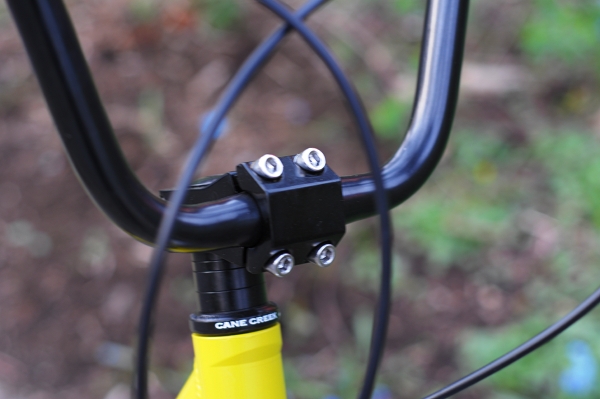 But while the lack of height adjustability is a drawback, I also discovered an unexpected benefit to the threadless stem: It is easier for me to work on. As mentioned before, I have problems with my hands that, frustratingly, make it mostly impossible for me to work on bikes. I know how to do most of the stuff and can give clear instructions to someone else, but typically lack the hand strength necessary to perform the operations myself. Not so with the Urbana bike. I first noticed that I was able to work on this bicycle, when we were putting it together and I tightened a bolt that I normally wouldn't have been able to. Later, I wanted to change the angle of the handlebars, so I watched this instructional video and did it - loosening and retightening the bolts with no problems. By contrast, I cannot even budge the bolt on a quill stem on my own. If threadless stems are generally easier to work on, then it's nice to have this bit of independence.


 This cup and saucer is marked on the bottom that it belonged to my grandmother, Alma Coe Green Williams. It also has a sticky tag on bottom that says 'Made in Japan'. I have no idea of it's age but I really like it. Notice the saucer has cut outs around the edge.

 I had never seen a Dutch
  This is S.T.'s 1973 Union "Savoy". It is a 22" straight step-through frame with 26" wheels, caliper brakes, 3-speed Sturmey Archer hub, dynamo lighting that runs off of a bottle generator, a vinyl chaincase, transparent dressguards, and lots of proprietary insignia.
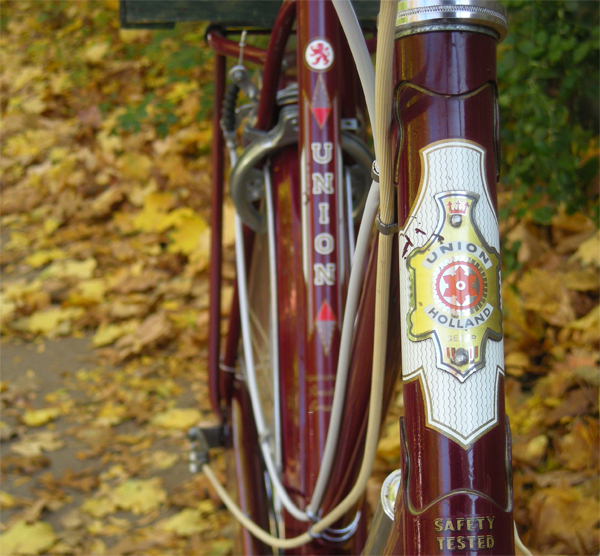 In geometry and feel, this
 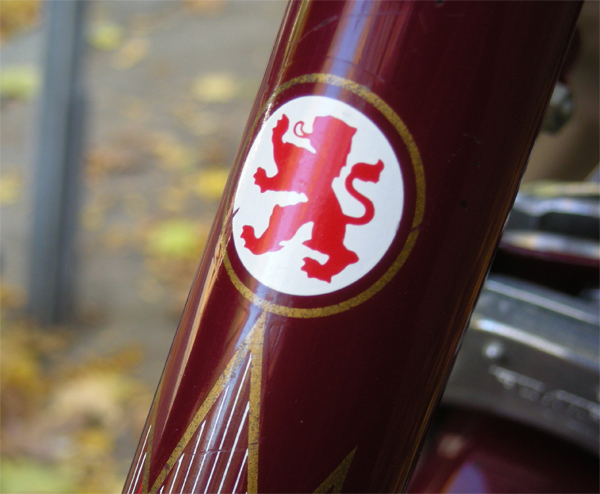 The rich bordeaux frame is covered with neat decals and pinstriping designs in gold and cream.
 It's all been preserved in great condition.
 I know that decals are not a big deal, but they do contribute to the overall look. The bordeaux, cream, and gold combination looks very regal.
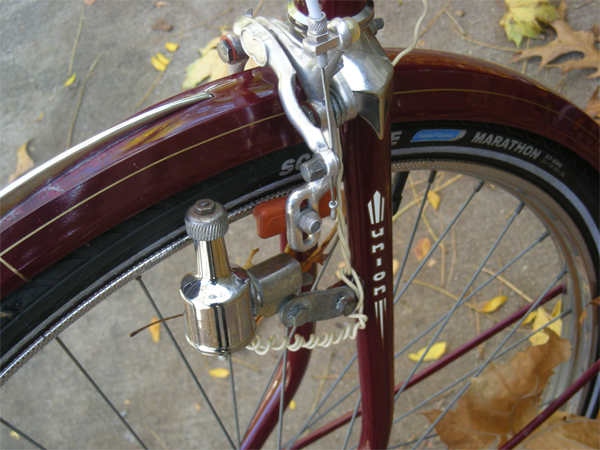 Chrome fork crown, caliper brakes, and bottle generator. I like the retro look of the bottle generators, but I am puzzled as to why bicycle manufacturers continued to use them when the Sturmey Archer dyno-hub has existed since the 1930s. Even today the Dutch seem to favour these over hubs - I wonder why?
 The matching vinyl chaincase is stitched together around the edges.
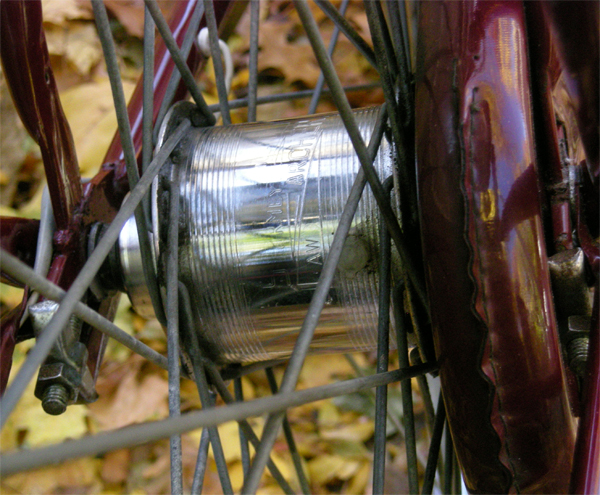 Here you can see the stitching, as well as the Sturmey Archer 3-speed AW hub.
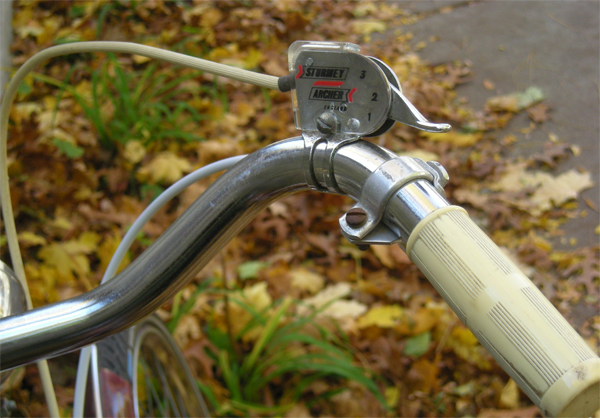 The gear shifter is remarkably well preserved, and the cream grips match the bicycle's colour scheme nicely.
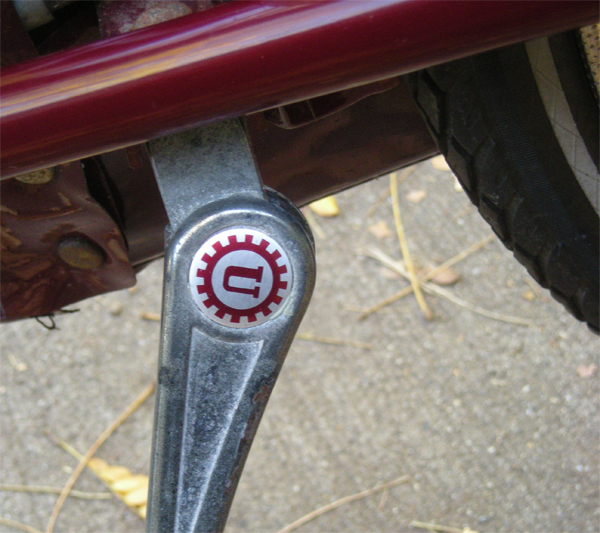 Proprietary emblem on the kicktand.
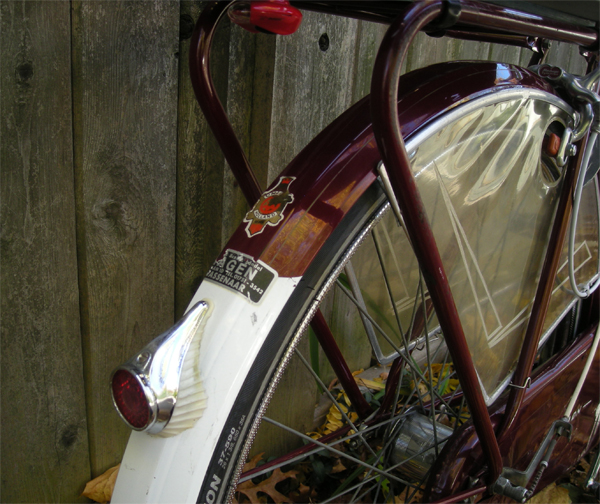 Rear rack and fender, with tail light and Spanniga rear light/reflector.
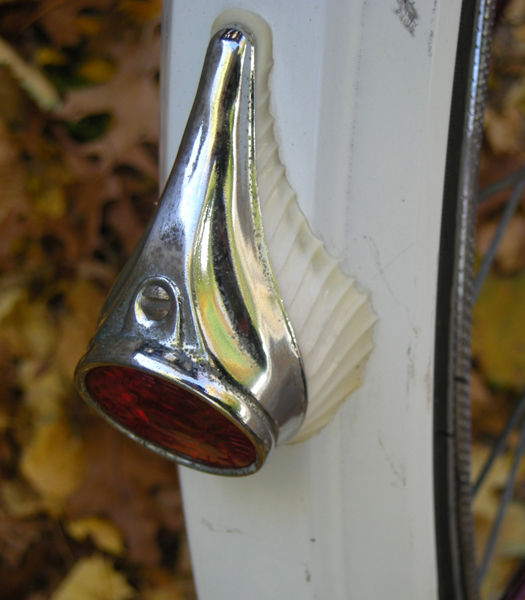 Here is a close-up of the gorgeous vintage Spanniga reflector. This alone makes me want the bicycle!
 S.T. uses this bicycle as her "commuter," and she has fitted it with this wooden crate that her father made for her while she was at college. She has also owned lady's
 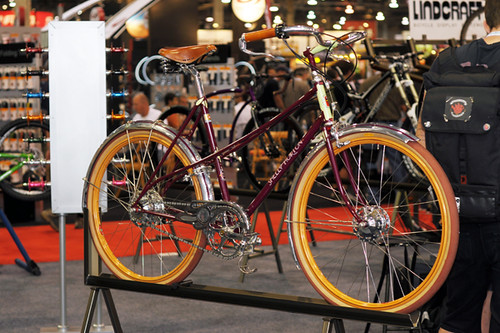 Some say that Interbike and NAHBS (the North American Handmade Bicycle Show) have begun to overlap in the past couple of years, and that was certainly my impression last week. I saw lots of handbuilt bicycles at the show - some familiar, and others by builders whose work I had never seen in person before, which was pretty exciting. But the funny thing was that most of them were being used to display components and accessories, rather than shown off in their own right. I admired an unusual bike by Signal Cycles, only to learn that its purpose was to demonstrate a motorised lift. I examined an unfinished frame, and was grimly told it was used to demo polishing tools. Nonetheless, as a lover of handmade bicycles I took the opportunity to photograph the ones on display and would like to share my favourites.
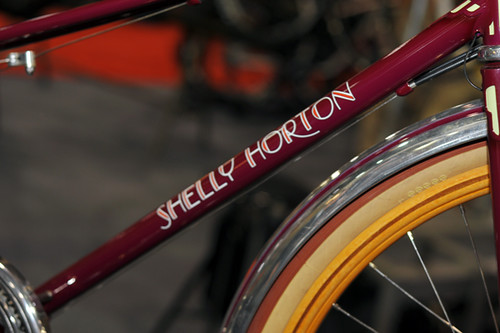 I could not believe my good fortune when I spotted the Shelly Horton mixte by Bilenky Cycles. Made for a collector, this mixte has an interesting story.
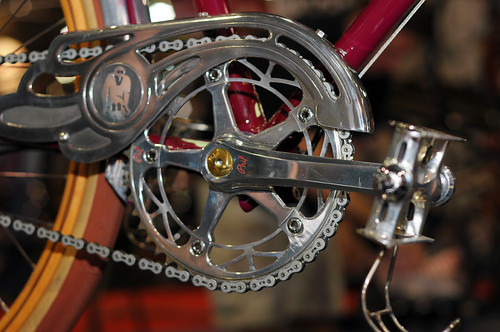 The mixte was part of a Phil Wood display, featuring their stunning custom crankset, bottom bracket, hub shells (housing Rohloff guts in the rear and Schmidt dyno up front), cogs, toe cages, etc. - all made as one-offs especially for this bicycle.
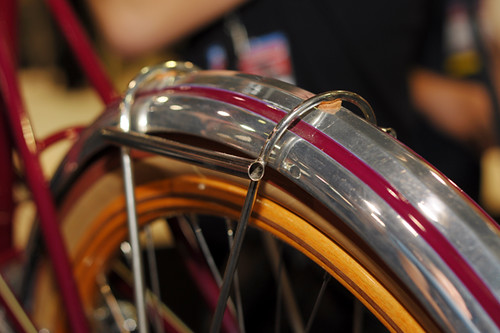 The custom Italian wheel rims feature actual wooden inlays. Pretty much every part of this bicycle is a one of a kind.
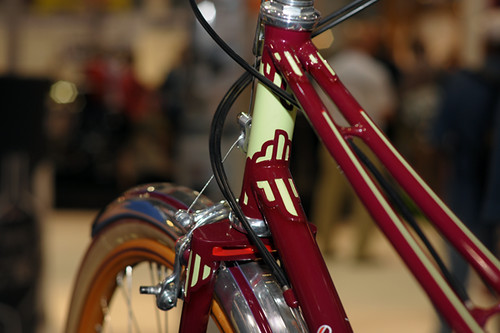 And then, of course, there is the art-deco inspired lugwork.
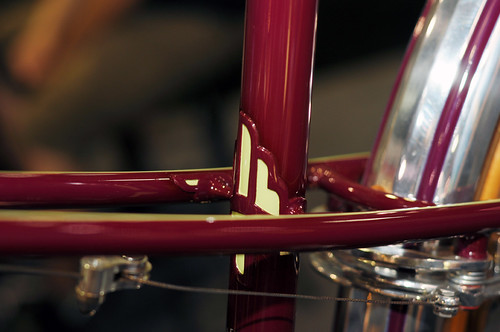 Though I would not choose this colour scheme for myself, it works well to set off the intricate lugs.
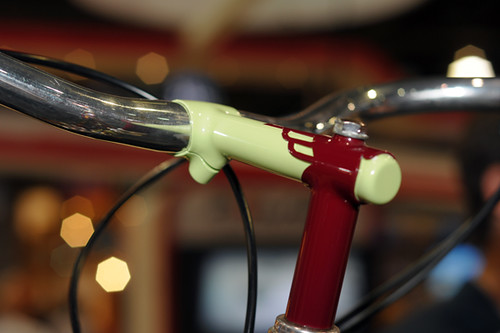 Custom stem, lugged and painted to match the frame.
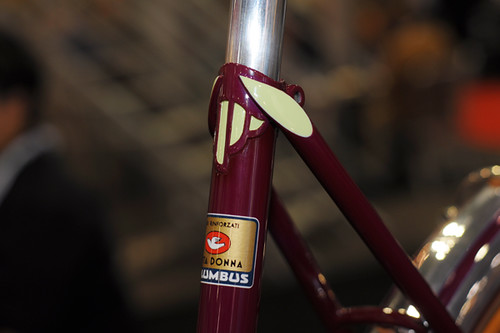 Seat cluster. And notice the Columbus "Donna" decal.
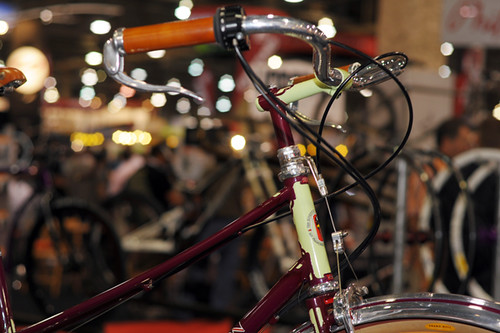 What do you think, would you ride this bike to the grocery store? Having read all about the Shelly Horton mixte, but never expecting to see it in person, finding it at Interbike was a wonderful surprise.
 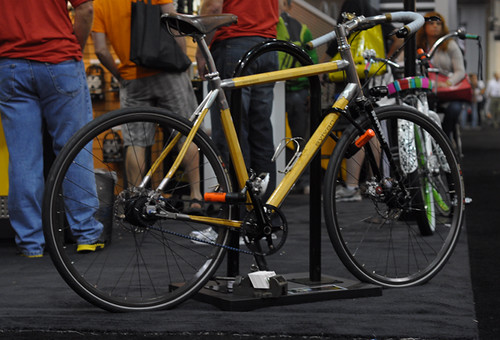 But now for something completely different, allow me to introduce "the pencil bike."
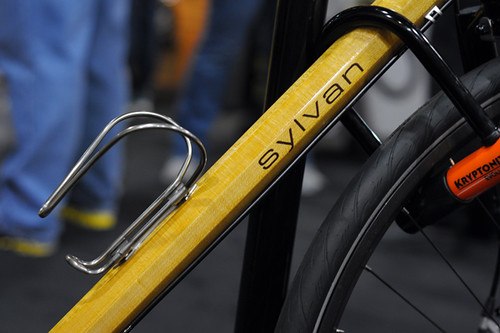 On display at the Kryptonite booth, this is a lugged wooden bicycle made by Sylvan Cycles. I cannot help but think of it as "the pencil bike," because - well, the faceted wooden tubes resemble pencils. It's a good thing; I think the bicycle looks friendly and approachable.
 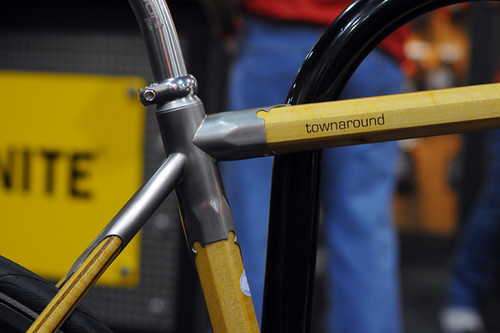 The Townaround is their hub-geared city bike model with upright handlebars.
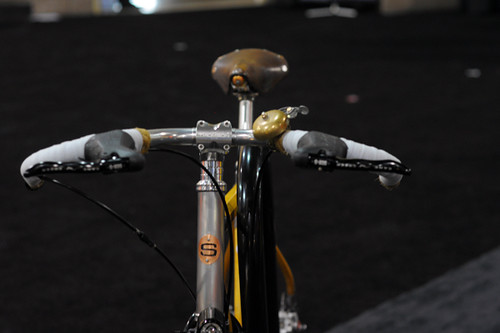 Having briefly written about Sylvan Cycles earlier, it was a real treat to see one in person. It looks great and I understand the frames are very durable: One of their bikes was apparently ridden in the D2R2!
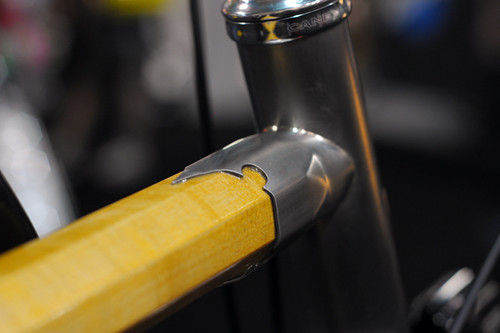 Close-up of the stainless lug sleeves. The tubes are maple.
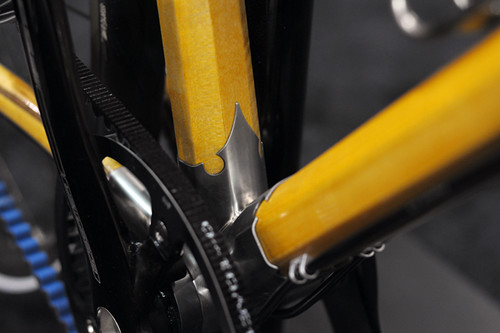 One of the interesting things about this model is that it is a belt drive, which I would love to try in of itself.
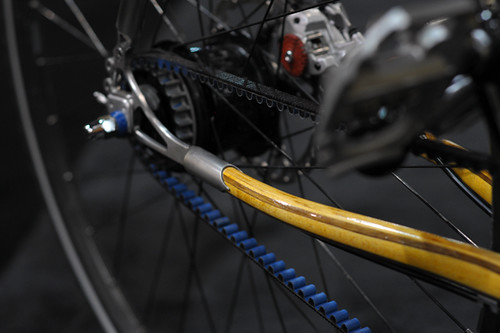 The curved chainstays are elegant, almost delicate-looking.
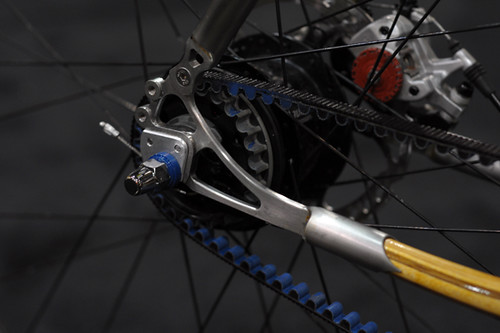 And the socketed drop-outs are just beautiful as well.
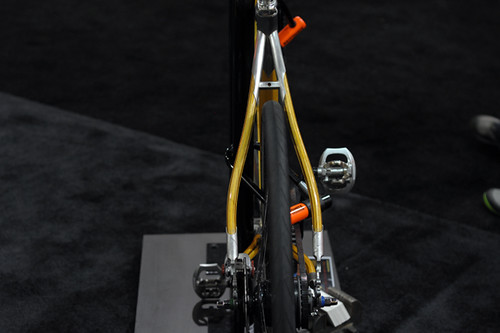 Will it fit fenders?
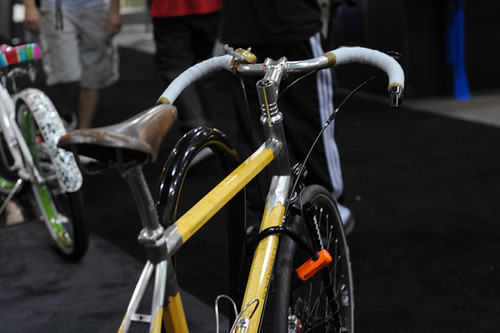 From the faceted maple frame to the belt drivetrain, the Igleheart fork and the handlebar setup, I like everything about the way this bicycle is built up. Maybe some day a shop in Boston will carry a demo model. And I would love to see people riding them on the streets.
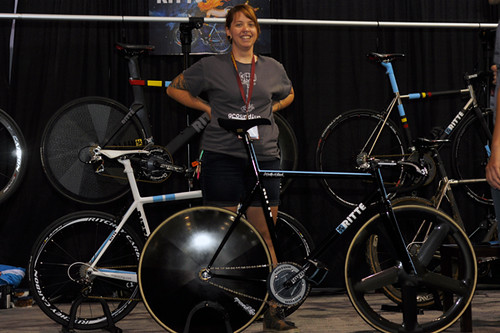
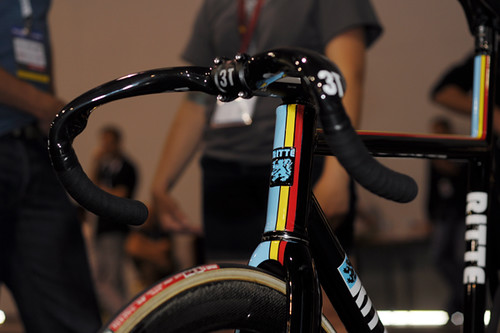 Finally, I would like to tell you about this bicycle at the Ritte booth. It is a handbuilt trackbike by framebuilder Megan Dean (Moth Attack!), and she made it for her boyfriend, Jack Lindquist.
 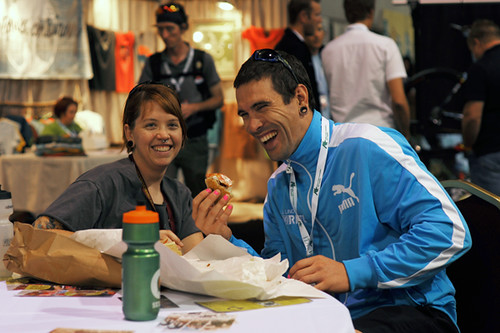 Megan and Jack are from LA and I met them at Cross Vegas the previous night (yes, I went to a cyclocross race!), where they were introduced to me as a framebuilder and a track racer. They are both so modest and low-key, that I was imagining something small scale (to be fair, half the cyclists I meet in Boston either race or build frames at least on occasion). In fact, Jack is a sprinter for Ritte Racing and Megan builds bicycles that crowds gather around in worshipful swarms.
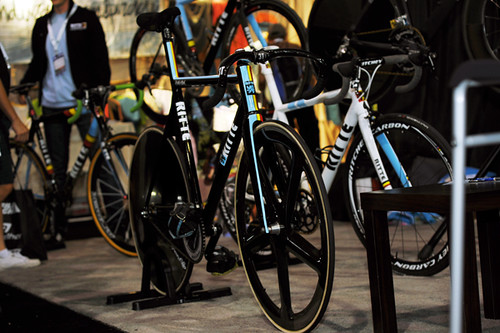 I mean jeez. When I heard that "Megan's frame is in the show, you should see it!" this was not what I pictured. This thing gave out a glow and energy that rendered spectators speechless. There were so many people gathered around the bicycle that getting a clear shot was almost impossible, but I didn't want to drag it away from the appreciative audience.
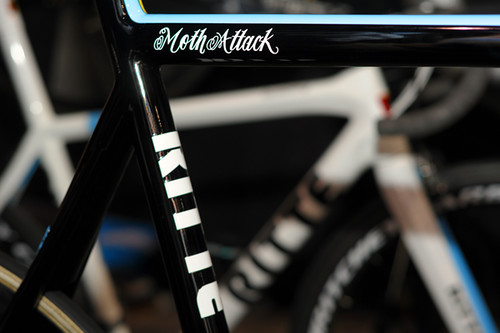 The frame is fillet-brazed steel, with a carbon fork. The joints are so smooth, they look liquid.
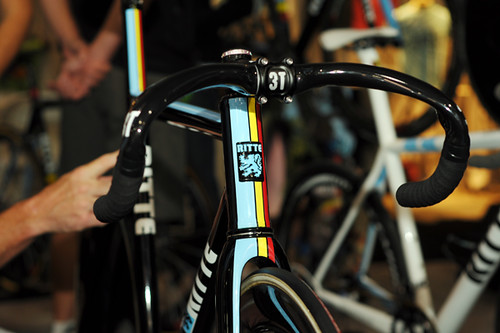 The process of making frames with tubing and angles like these is completely alien to me, and I had a hard time wrapping my mind around the fact that this was built by hand - especially since everything looks so flawless.
 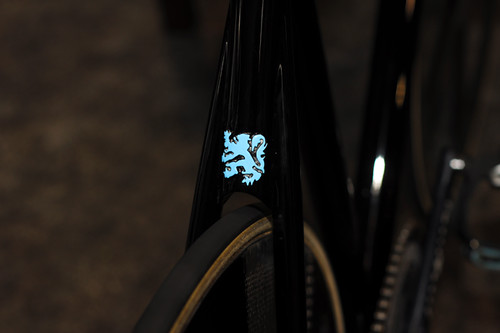 According to Megan, the frame was not difficult to build overall, except for the tricky seat stay attachment.
 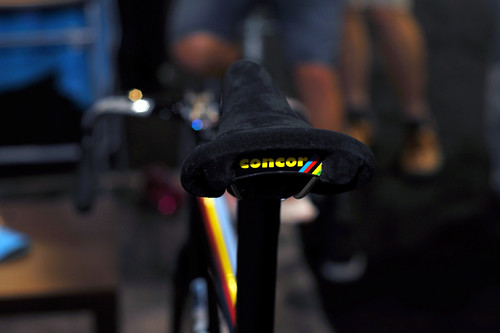 Not difficult! My hat's off to you, Megan.
 Although Interbike was not about handbuilt bicycles, the ones on display undoubtedly stood out against the backdrop of mass produced wares, and I felt it only right to honor them. Handbuilt bicycles inform industry trends down the line, and the influence of custom randonneurs, mixtes, and other unique creations exhbited at NAHBS earlier could be readily observed in booth after booth at Interbike. Should we expect a line of "pencil bikes" from one of the big manufacturers in the near future? Time will tell.